I was at the library today to pick up a book I need for some research I'm doing on Matilda of Tuscany. I had requested the book a few days back, and it came back faster than I expected it to. While at the counter, the young man working there looked hard at me.
"Were you at that poetry reading thing?"
Oh. Which one? "The Red Cedar Review?"
"Yeah. You were really good."
"Thank you."
Every time I get a compliment (which is frequently, these days), it makes me so happy. People like my poetry. They like my performances.
I always dreamed about people liking my poems when they read them. I never thought about being a big deal as a poet performer.
But I've been thinking a lot since my last reading last Thursday, and I'm increasingly wondering if I can do this for a living. I think I would like that. It just never occurred to me to be more than just someone who writes; I haven't thought about being a talent who also reads. But maybe I should give it some more thought. Maybe I should consider making it work.
Tuesday, April 27, 2010

Two Poetry Events, One Day
 Just a friendly reminder that the Center for Poetry will be having a poetry chalking on Thursday the 29th from 2:30 to 4:30 in front of Phillip-Snyder. Basically, you bring yourself and chalk a poem. You don't have to bring a poem, though you are welcome to do so. Hopefully, the weather will be beautiful.
Also, yes, it is indeed Poem in Your Pocket Day this Thursday as well. :)
The Little Princess
 The Little Princess is that older, Shirley Temple film following a young, wealthy woman during the Boer War, based on the novel of the same name. In the story, Temple's character, Sarah Crewe, enters a young ladies school run by the miserable spinster Miss Minchin. After her father is believed to be dead, Sarah becomes a servant at the school, begins living in the attic and is treated harshly by many of the other students. Sarah begins to visit a Veterans' Hospital, convinced that he is not dead.
What is most interesting in this film is race, or rather the lack of race. The Second Boer War took place in South Africa, and involved Africans, who were caught between Boers (of Dutch ancestry) and the British, who died as soldiers. It does not it mention the horrific concentration camps that were used as part of the British government's attempt to destroy the Boers, and, in turn, Africans. (Over 12% of Africans in these concentration camps died.) Not that you could ever guess all of that, watching this movie. The movie is entirely from the point of view of –you guessed it!- whit
 e people.
The film has Others in it and they're sidelined for the more important story of a young white woman. There’s Becky, the young maid that Temple’s Sarah befriends. In the newer version, she was depicted as a young black woman. In this movie, she’s white, though there’s something exotic about her looks, much like Sissy Jupe in Dickens's Hard Times. And, as always, her struggle is overlooked to tell the story of a Sarah, who has only recently began to see what real poverty is like, and ultimately gets out of it. There is also the character Ram Dass, the magical Other of the story. He somehow creates wonderful things for Sarah, helping her. No one ever helps or acknowledges the struggle of these two minority characters within the movie. They just exist to aid the narrative.
This film is enlightening in the sense that, if you're familiar with South African history, it shows how easily whitewashed stories can become.
Monday, April 26, 2010
"Read the Last Poem"
I was in the English department office to drop off a paper and I noticed someone reading the latest issue of The Red Cedar Review. Obviously, I had to tell her that the last poem was really good. :)
Is this what it feels like to be an author? To know someone is going to read your work but keep it out of mind until confronted with proof that yes, someone is going to read your work?
I suspect the woman I told that to was unimpressed, but seeing it was nice.
I'm still trying to keep an eye out for the issue on Amazon, but so far, no luck.
Thursday, April 22, 2010
Issue Release Party
Just got back from the party tonight. I had a wonderful time. :) Amelia dared me at the meeting last night to come in a cape and appear on stage in a cloud of smoke. I didn't have a cap, so I did the best I could with a pink feather boa, which also went over well. I got there early and helped with balloon making, and before you knew it, the party got started.
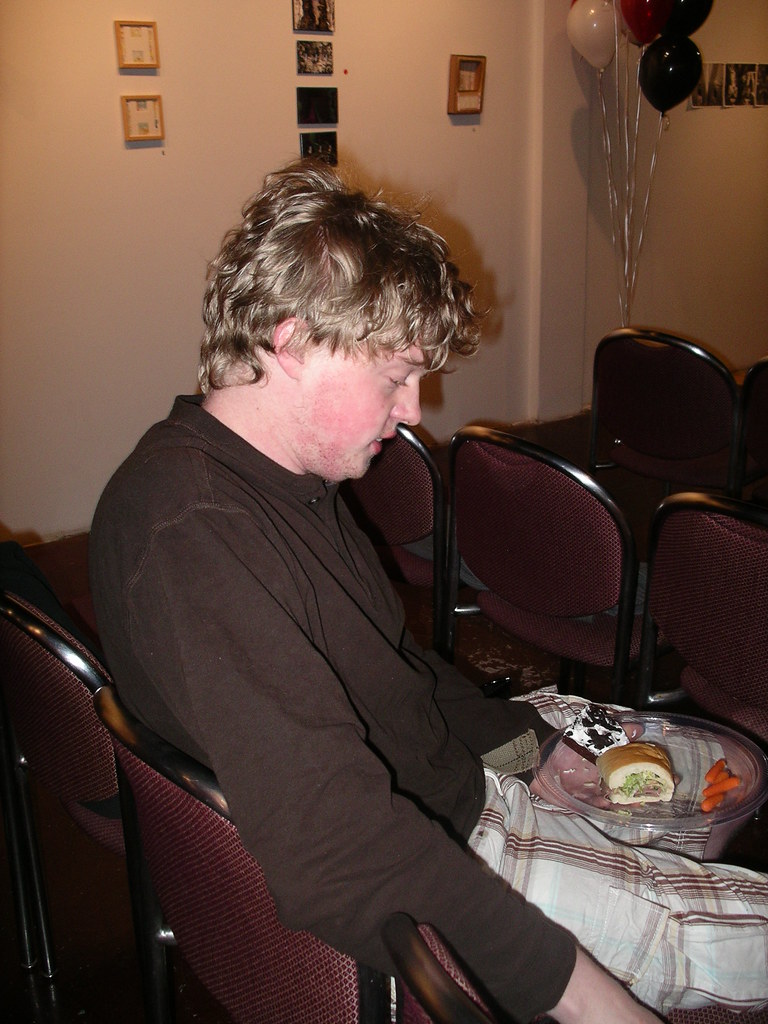
One of the really nice things about events like these is that it's an opportunity for contributors and their families to come out and see the staff and celebrate their publication. Here is Erin Wisti's older brother. She just published a piece with us called "Here for the Littering," which is about her experience living with her father while he was receiving chemo.

And at the same time, Brian, next year's poetry editor, got to meet with Kelly's Mom.
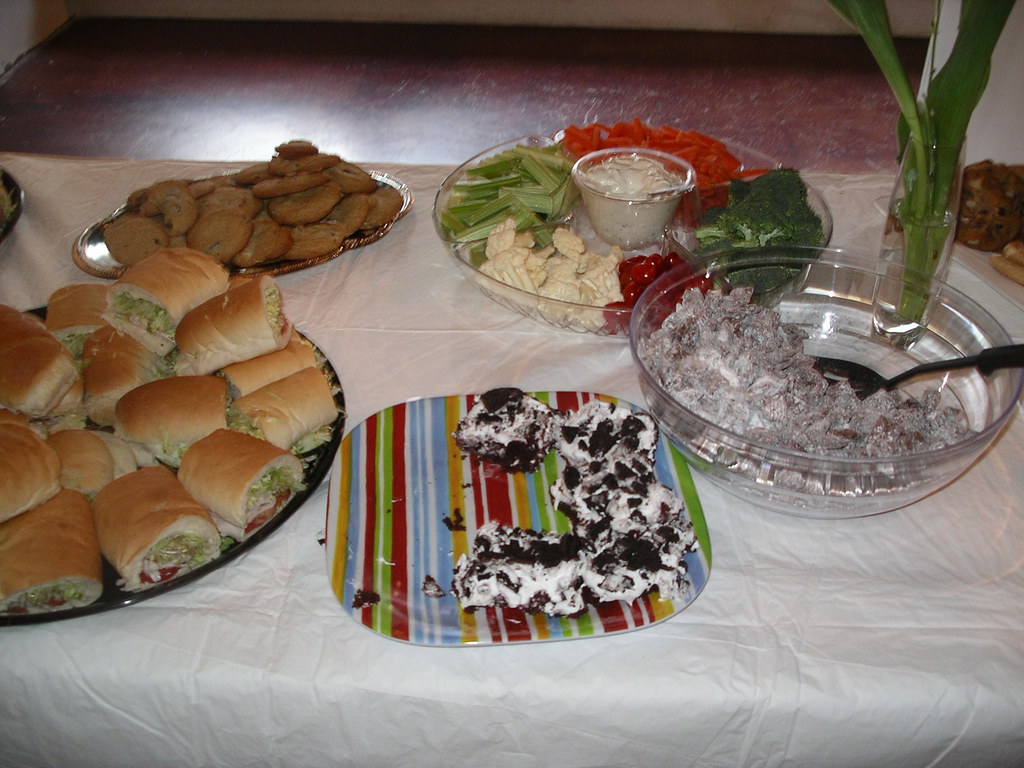
We always have nice food, including puppy chow, one of my favorites.
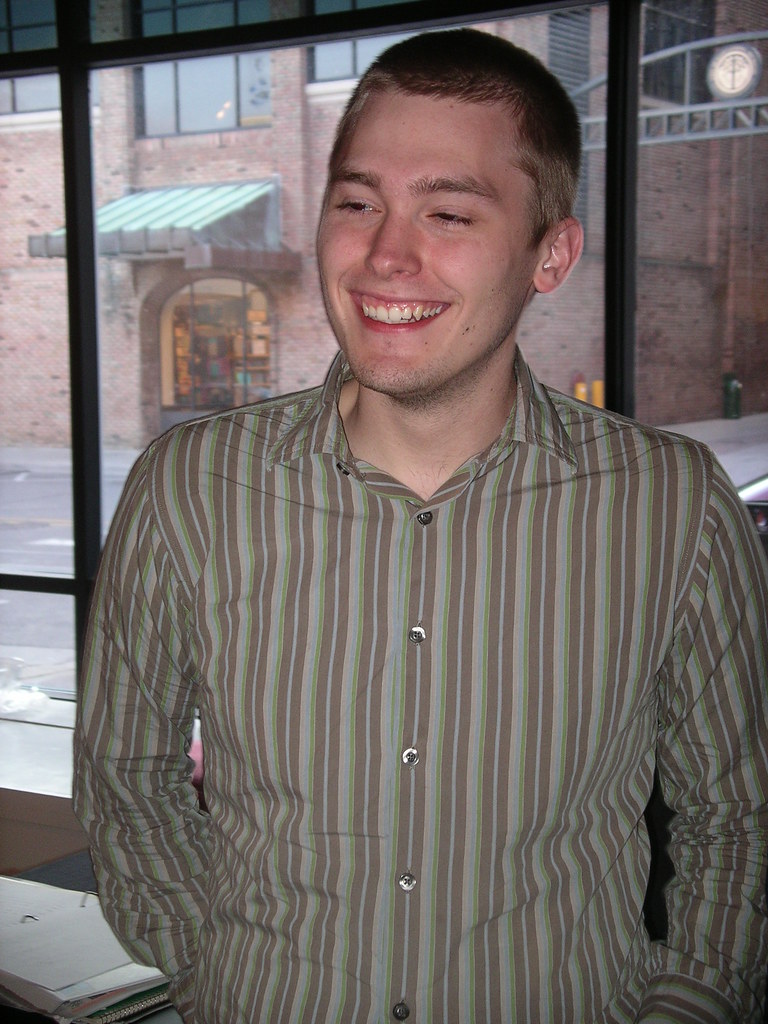
We even had some of our prospective staff members come join us for the party, including my friend Mark here. Mark works with me over at the Center for Poetry, where he's been a big help with running things.
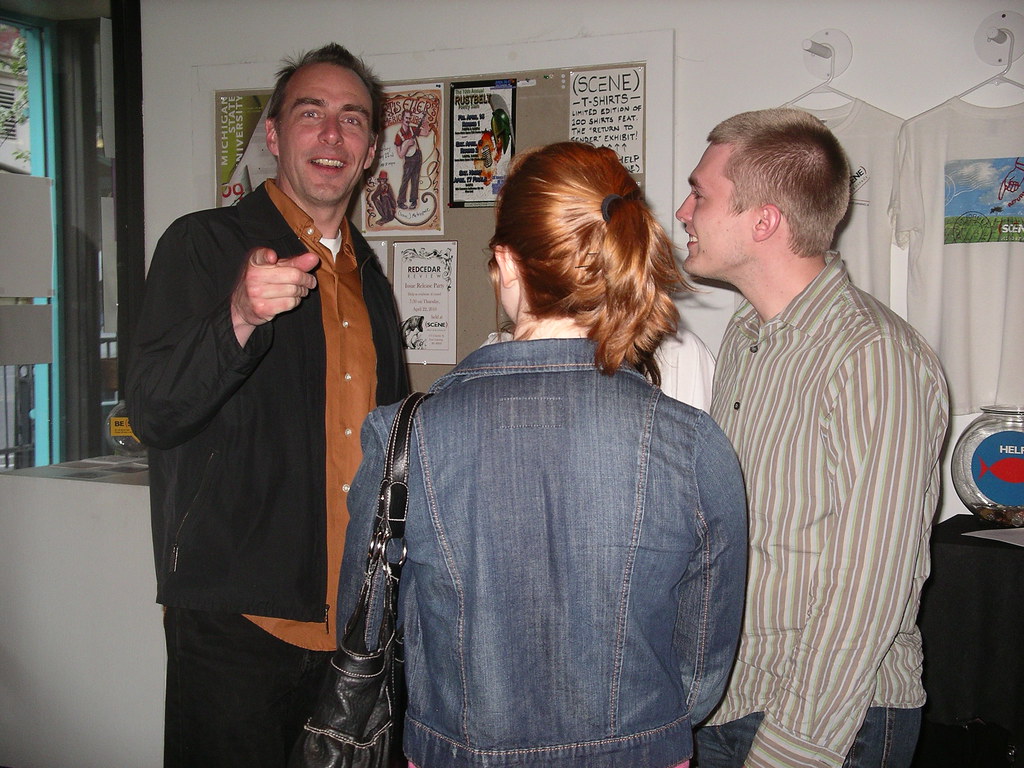
Lastly, this is good chance to talk to some of the department's coolest professors. Here, Dr. Healey, this year's adviser, talks with Mark and his girlfriend Ally.
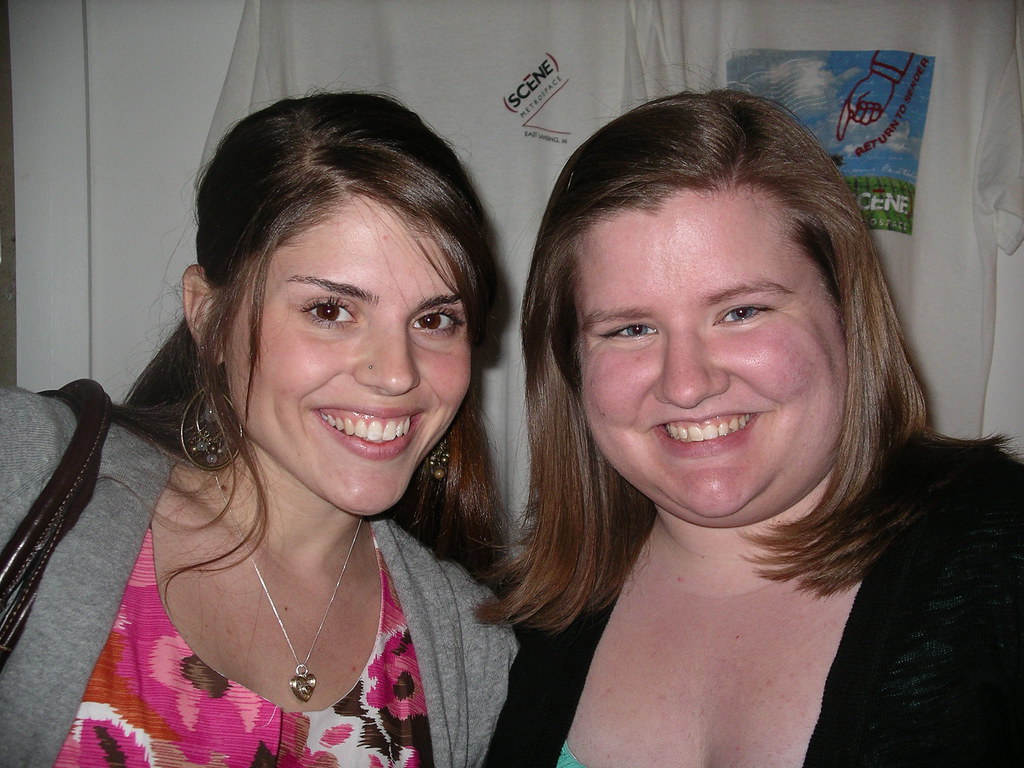
I'm really going to miss the editors for this year's journal, Ashley and Emily. I really loved getting to know Ashley this year. Emily and I have been friends for years now. I can't believe how long ago it was that we first met and had our first four classes together. It seems like it was yesterday. Both of them have so much to be proud of, since publishing a journal is hard work, and it looks great this year.
We also had some really wonderful readers for this year's party. Lia Greenwell, Kelsey Jenko, Erin Wisti and I, all contributors, were able to read our own pieces.
I'm happy to say that my reading went really well. Lia loved that I didn't even acknowledge my silly boa, but still read really serious pieces. (Two love poems and a dramatic monologue.) I mentioned last post that I wanted to sound like Carolyn Forche, and someone actually mentioned that I sounded like God's wrath. Yes! Mission accomplished. I'm glad everyone enjoyed me reading.
Kelsey approached me after the reading to ask me if I'd like to read at some poetry readings she's hoping to organize this summer. I told her I was totally game. I want to keep working on reading. Also, it would be a great chance to meet other poets and hang out with poets I already love, like Jon James and Dr. Healey.
As always, there are more pictures on my Flikr account.
Thanks to everyone who came out tonight. Everyone at the journal really appreciates your support. Don't forget to buy at copy through the MSU Press if you haven't done so already.
Wednesday, April 21, 2010
Red Cedar Review Party Tomorrow
The Red Cedar Review will be having its annual Issue Release Party tomorrow. I got a copy of the new issue in my hands tonight, and I can tell you that it's wonderful. The poetry is extremely impressive. I love the poems "rebirth," "The Statues of Vaison-la-Romaine," "Twice-born," and "Lepidoptery." I just read "Just Here for Littering," and it was so good. Midway through the piece, the author describes someone called The Candy Man, and by the end of the paragraph, you want to die inside, because it's so sad. There's even a delightful comic mid-way through the book involving a hamster fishing.
I've been asked to read. I'll be reading last.
Picking out poems to read is always a struggle for me. I went through quite a few poems before settling on the three I'll be reading. I considered reading "On Why Bureaucracies Work the Way They Do," which I read at my last poetry reading and has been published. Since I know they'll be some of the same people there, I wanted to avoid reading all the same stuff I've recently read to them. I also thought about reading "Vinyl Says Something on the Record," which was one of my most recent poems. I submitted it as part of my manuscript for the Live Lit, but it was the one poem I choose not to read, since I think it's still too early to tell if it's really done or not. I also considered pulling something from a manuscript I have called Satellites. It's an entire collection of poems about relationships, though not necessarily the romantic kind. I have other poems, some based on family stories about farming, others rewriting ancient Greek myths, one on marriage, and even one done as a surreal feminist piece. Basically, I have a lot of strange stuff, and then I have love poems. I'm hesitant to read three love poems in a row, because I feel like love is boring in comparison to other stories unless it's happening to you. I think my love poems are good because they are so different, but that listeners don't want three in a row.
Then I have to practice reading them. Kelly and Ashley, our new editor and our current editor, respectively, have both mentioned I have a voice that makes people want to listen. I have to work to get that. Several years ago, I saw Carolyn Forche give a reading. I was lucky enough to meet her beforehand. She was so nice and I really liked her and didn't think much about her voice, which just sounded normal. And then she read, and she sounded so powerful that I felt as if God's wrath was about to come down on me. It was that stunning. I've never, before or since, been afraid at a poetry reading, or felt like a void opened up inside of me. I would like my listeners to be struck at that same level, though not always that way. I'm going to become a better poet and a better reader, and one day, that's what I'll do to people. If I'm not already.
So I'm settling with a few poems. You should come out tomorrow to hear them, to see what I read, if it's decent, if I get tongue-tied or not. 7:30 pm at Scene Metrospace. You won't be sorry you came.
I've been asked to read. I'll be reading last.
Picking out poems to read is always a struggle for me. I went through quite a few poems before settling on the three I'll be reading. I considered reading "On Why Bureaucracies Work the Way They Do," which I read at my last poetry reading and has been published. Since I know they'll be some of the same people there, I wanted to avoid reading all the same stuff I've recently read to them. I also thought about reading "Vinyl Says Something on the Record," which was one of my most recent poems. I submitted it as part of my manuscript for the Live Lit, but it was the one poem I choose not to read, since I think it's still too early to tell if it's really done or not. I also considered pulling something from a manuscript I have called Satellites. It's an entire collection of poems about relationships, though not necessarily the romantic kind. I have other poems, some based on family stories about farming, others rewriting ancient Greek myths, one on marriage, and even one done as a surreal feminist piece. Basically, I have a lot of strange stuff, and then I have love poems. I'm hesitant to read three love poems in a row, because I feel like love is boring in comparison to other stories unless it's happening to you. I think my love poems are good because they are so different, but that listeners don't want three in a row.

Then I have to practice reading them. Kelly and Ashley, our new editor and our current editor, respectively, have both mentioned I have a voice that makes people want to listen. I have to work to get that. Several years ago, I saw Carolyn Forche give a reading. I was lucky enough to meet her beforehand. She was so nice and I really liked her and didn't think much about her voice, which just sounded normal. And then she read, and she sounded so powerful that I felt as if God's wrath was about to come down on me. It was that stunning. I've never, before or since, been afraid at a poetry reading, or felt like a void opened up inside of me. I would like my listeners to be struck at that same level, though not always that way. I'm going to become a better poet and a better reader, and one day, that's what I'll do to people. If I'm not already.
So I'm settling with a few poems. You should come out tomorrow to hear them, to see what I read, if it's decent, if I get tongue-tied or not. 7:30 pm at Scene Metrospace. You won't be sorry you came.
Kurt and Courtney
 Kurt and Courtney is a difficult documentary following a filmmaker, Nick Bloomfield, trying to make a documentary about Kurt Cobain while being thwarted by Cobain's widow, Courtney Love. I say difficult because the film demonizes Love while itself showing how so many have demonized her.
As a fan of both Nirvana and Hole, I found myself fascinated with many aspects of the story. For Nirvana fans, what really drove Cobain to suicide will always be the Holy Grail. Nirvana was a band seemingly created for the teenager with suicidal tendencies, since it acknowledged the agony so many teenagers face, but also armed them with anger, exhilarating them with it to the point of strength. Cobain's suicide will always hum in the background of his music and in the back of fans' minds.
The film does successfully show a world where many people were more than happy to exploit Cobain. The film wants to point the audience at Love's exploitation, but it inevitably shows that she was in no way the only one (or, it could easily be argued, the worse, since Love appeared to be pushing Cobain towards his full potential and not simply using him.) Several times in the film, Bloomfield shows people who claim to have known Cobain, but without any real evidence. Instead, they want to bask in the spotlight, even if it's one of someone else's making.
The hatred directed towards Love, an ambitious woman, was m
 ore fascinating and far more telling than the rest of the movie. Many of the men in the film complain that Love is too ambitious, one discussing how she made lists of ideas to help promote a punk rock boyfriend in her pre-Cobain life. Instead of seeing this for what it probably was, a woman who wanted her lovers to succeed at what they loved doing, they complain that she was using them, even to the point where one former lover complained that he would have committed suicide had they stayed together.
Love's father is particularly telling. In the interviews with him, he calls his daughter all sorts of nasty names and complains, ultimately, that she wasn't obedient enough. If anything, I found myself thinking that Love grew up with that kind of patriarchy and rebelled aganist it. As a feminist, I found myself liking Love more than I previously did.
Perhaps the real problem was that Love, who had ambitions not only for Cobain, but for herself, wasn't womanly enough. I was saddened to see that the film made no mention of the inherent misogyny in so much rock music, or that Love, in being an active part of Cobain's music career, was really subverting traditional ideas about women's place in art, who wanted to not only serve as muse but as a creator. It also then makes Cobain look like he was without agency, which, as a young white man with millions of dollars and fans, he most certainly was not. Cobain himself was a vehement feminist, and would probably be disappointed that the discussion of his suicide has focused mostly on his "evil" wife instead of on the more obvious and less easy answers for why people kill themselves.
The only thing in the film I can't completely dispute at this time is the scenes involved the ACLU. Love herself has been a member of the organization for many years. Bloomfield goes to one of their dinners to interview her publicly over Cobain's death. The scene included in the documentary
 shows her about to give a speech as Bloomfield interrupts to ask her questions. It should be pointed out that Love has the right to refuse interviews and, since she is in partial control of Nirvana's music, also has the right to refuse Bloomfield's request to feature Nirvana's music in the documentary. In harassing her at a dinner where she is about to give a speech, he himself is cutting off her right to speak. There's something almost stalker-like about Bloomfield and his quest to get Love in the film. Given that Bloomfield doesn't lack for interviewees or material, why he needed to say anything beyond "Love refused to be interviewed and has not allowed me the rights to Nirvana's music for this documentary" is unclear.
Bloomfield concludes at the end of the film that there isn't enough evidence to point to Cobain's murder. He does, however, finger Love as the largest contributor to Cobain's suicide. Instead of depicting it as it most probably was, marital issues compounded by fame, drugs and depression, Bloomfield makes Love the villain, who drove Cobain to kill himself. It's irresponsible at best to twist the story this way, instead of telling the truth: that the only one who could possibly shed light on Cobain's suicide is Cobain himself, and that even if we could talk to the dead, there's a chance not even he fully understands what drove him to self-annihilation.
Subscribe to:
Posts (Atom)